Deep drawing presses are industrial forming machines used to transform flat metal sheets or blanks into three-dimensional shapes through controlled deformation. The process is widely used for producing cylindrical, rectangular, cup-shaped, and other hollow components with consistent dimensions.
Modern deep drawing press systems combine hydraulic or mechanical pressing mechanisms, dies, punches, material-handling equipment, sensors, automation controls, and safety systems. They are used across automotive, aerospace, appliance, cookware, electrical, packaging, and general metal manufacturing applications.
Context
What Is a Deep Drawing Press?
A deep drawing press is a machine that forces a sheet-metal blank into a die cavity using a punch. The material flows into the die and takes its required shape without being cut away from the original blank.
The process differs from simple bending because the sheet undergoes substantial plastic deformation to create a deeper three-dimensional form. Depending on the geometry, multiple drawing stages may be required.
How Deep Drawing Works
A typical deep drawing operation involves several coordinated stages:
- A sheet-metal blank is prepared.
- The blank is positioned over the die.
- A blank holder applies controlled pressure.
- The punch moves into the die cavity.
- The sheet flows around the punch and into the die.
- The formed component is removed.
- Additional drawing, trimming, or finishing operations may follow.
Material properties, blank dimensions, punch geometry, die geometry, lubrication, and forming force all influence the resulting component.
Main Components of a Deep Drawing Press
A deep drawing press generally contains several mechanical and control components.
| Component | Primary Function | Typical Consideration |
|---|---|---|
| Punch | Forms the sheet into the die | Shape and dimensions |
| Die | Provides forming cavity | Radius and geometry |
| Blank Holder | Controls material flow | Holding force |
| Press Frame | Supports machine structure | Rigidity |
| Hydraulic System | Generates controlled force | Pressure and flow |
| Drive System | Produces press movement | Speed and stroke |
| Sensors | Monitor machine conditions | Position and force |
| PLC | Controls operating sequence | Automation logic |
| HMI | Provides operator interface | Monitoring and setup |
The configuration varies according to press type, forming requirements, production volume, and component geometry.
Hydraulic Deep Drawing Presses
Hydraulic presses use hydraulic cylinders to generate forming force. Their stroke, pressure, and movement can be controlled through hydraulic valves and electronic systems.
Hydraulic systems are widely used for deep drawing because forming force and ram movement can be controlled across different stages of the operation.
Mechanical Deep Drawing Presses
Mechanical presses use mechanisms such as crankshafts, eccentric drives, or link systems to move the slide.
They can provide rapid repeated cycles and are commonly integrated into automated sheet-metal production lines.
Servo Press Systems
Servo presses use electronically controlled motors and mechanical transmission systems to regulate slide movement.
Programmable motion profiles can provide greater control over speed, position, and forming sequences for selected applications.
Importance
Why Deep Drawing Presses Matter
Deep drawing allows manufacturers to create hollow metal components from relatively flat sheets. The process can produce geometries that would be difficult to achieve through basic bending operations.
It is particularly useful where repeatable dimensions, controlled wall geometry, and high-volume production are required.
Material Flow Control
Material flow is one of the central considerations in deep drawing. Excessive or insufficient blank-holder force can contribute to defects such as wrinkling or tearing.
Press systems therefore need suitable control of forming force, punch movement, blank-holder pressure, and lubrication.
Metal Materials
Deep drawing can be performed with various sheet materials depending on their ductility and forming characteristics.
Common materials include:
- Low-carbon steel
- Stainless steel
- Aluminum alloys
- Copper
- Brass
- Selected nickel alloys
Material selection depends on the required mechanical properties, thickness, corrosion characteristics, surface requirements, and final application.
Tooling Design
The punch and die determine the shape of the finished component. Tool geometry must account for material thickness, forming depth, corner radii, clearance, and expected material flow.
Tooling can be manufactured using precision machining and specialized surface-finishing processes.
Production Consistency
Automated press controls can monitor position, force, speed, and other parameters during repeated cycles.
Data from sensors can help production teams identify changes in machine behavior or process conditions.
Metal Forming Technologies
Single-Stage Deep Drawing
Single-stage drawing forms the component in one principal drawing operation.
This approach can be appropriate for parts with relatively moderate depth-to-diameter relationships and suitable material characteristics.
Multi-Stage Deep Drawing
Deep or complex components may require multiple drawing stages. Each stage progressively changes the geometry while controlling material deformation.
Intermediate annealing or other processing steps may sometimes be required depending on the material and deformation level.
Redrawing
Redrawing involves passing a previously drawn component through another die to reduce its diameter or increase its depth.
Multiple redrawing operations can create deeper components while managing deformation across successive stages.
Reverse Drawing
Reverse drawing changes the direction in which the material is formed relative to an earlier operation.
It can be used for selected geometries where conventional drawing sequences are unsuitable.
Hydroforming
Hydroforming uses pressurized fluid to form sheet or tubular materials against a die.
Although different from conventional deep drawing, hydroforming is another advanced metal-forming approach used for specialized component geometries.
Press Systems and Automation
Press Control Systems
Modern deep drawing presses can use PLC-based control architectures to coordinate the forming cycle.
The controller can manage ram movement, blank-holder operation, lubrication sequences, material handling, and safety interlocks.
Sensors
Sensors can measure:
- Ram position
- Forming force
- Hydraulic pressure
- Die position
- Blank presence
- Temperature
- Machine vibration
Sensor information can be used for monitoring and process control.
Automated Material Handling
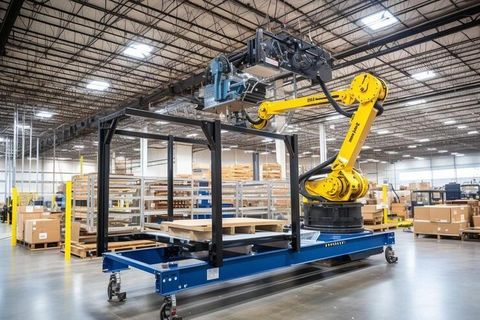
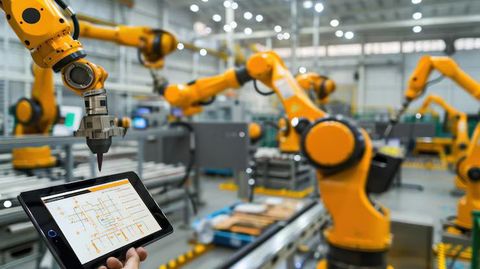
Large production lines may use robotic arms, transfer systems, conveyors, or mechanical feeders to move blanks between operations.
Automated handling can synchronize material movement with press cycles and downstream processes.
Transfer Presses
Transfer presses use mechanisms to move workpieces between multiple dies within a press system.
This configuration can combine drawing, forming, piercing, trimming, and other operations into a coordinated production sequence.
Progressive Press Systems
Progressive stamping systems move sheet material through multiple die stations. Each station performs a defined operation as the strip advances.
Progressive systems are particularly relevant for smaller components produced in repeated sequences.
Industrial Applications
Automotive Manufacturing
Deep drawing presses are used to manufacture selected vehicle components, including body panels, structural components, brackets, housings, and other formed parts.
Automotive production often combines deep drawing with stamping, trimming, piercing, joining, and surface-finishing operations.
Aerospace Components
Aerospace manufacturing uses formed sheet-metal components for selected structural, engine, interior, and equipment applications.
Material selection and dimensional control are particularly important because aerospace components can have demanding mechanical and environmental requirements.
Household Appliances
Washing machines, refrigerators, ovens, air-conditioning equipment, and other appliances contain formed metal housings and components.
Deep drawing can produce containers, panels, shells, and other shaped parts.
Cookware
Pots, pans, containers, and similar products can be produced using deep drawing processes.
Aluminum, stainless steel, copper, and other materials may be used depending on the application.
Electrical and Electronic Equipment
Deep-drawn metal housings can be used for electrical enclosures, connectors, shielding components, and other equipment.
The process can produce rigid shapes while retaining relatively uniform material thickness in suitable designs.
Industrial Containers
Metal cans, cylinders, housings, and specialized containers can be manufactured through drawing and related forming processes.
The die configuration depends on the required geometry and material.
Manufacturers and Suppliers
The deep drawing equipment ecosystem includes manufacturers of hydraulic presses, mechanical presses, servo presses, transfer systems, tooling, automation equipment, and control systems.
When evaluating manufacturers or suppliers, organizations can examine:
- Maximum forming force
- Working area
- Stroke length
- Operating speed
- Press accuracy
- Blank-holder configuration
- Automation compatibility
- Die dimensions
- Control architecture
- Safety systems
- Maintenance requirements
- Technical documentation
Equipment selection should be based on the component geometry, material, sheet thickness, production volume, and required forming sequence.
Recent Updates
Servo Press Technology
Servo-driven presses provide programmable slide motion and can adjust movement profiles during the forming cycle.
This can support greater control over material flow for selected forming applications.
Digital Monitoring
Modern presses can collect information about force, position, pressure, cycle time, and equipment status.
Historical data can support process analysis and equipment monitoring.
Smart Manufacturing
Deep drawing presses can be integrated with manufacturing execution systems, production databases, and industrial networks.
Connected equipment can transmit production and machine information to centralized monitoring platforms.
Automated Inspection
Machine-vision systems and dimensional inspection equipment can evaluate formed components for selected defects and dimensional characteristics.
Automated inspection can be integrated with production lines depending on throughput and inspection requirements.
Predictive Maintenance
Vibration, temperature, hydraulic pressure, motor current, and other equipment data can be analyzed to identify changes in machine condition.
Such analysis can help maintenance teams investigate potential mechanical or hydraulic issues.
Energy Monitoring
Hydraulic and mechanical presses can consume significant amounts of electrical energy during production. Energy-monitoring systems can track consumption across machines and production periods.
This information can support engineering analysis of equipment operation and plant energy management.
Laws or Policies
Machinery Safety
Deep drawing presses contain significant mechanical and hydraulic forces. Machine safeguarding can include physical guards, emergency stops, interlocks, light curtains, and controlled access.
Applicable machinery-safety requirements depend on the machine design and operating jurisdiction.
Occupational Safety
Operators and maintenance personnel need appropriate procedures for machine setup, tooling changes, material handling, maintenance, and stored-energy control.
Training and documented procedures should reflect the specific press configuration.
Hydraulic Safety
Hydraulic systems operate under pressure and require suitable inspection, maintenance, and pressure-control measures.
Hoses, fittings, cylinders, valves, and pressure vessels should be maintained according to applicable engineering requirements.
Electrical Safety
Press-control systems contain electrical equipment that requires appropriate grounding, protection, inspection, and maintenance.
Applicable electrical standards depend on the installation environment and jurisdiction.
Environmental Considerations
Metal-forming operations may involve lubricants, hydraulic fluids, metal scrap, and other industrial materials.
Facilities should manage these materials according to applicable environmental and waste-handling requirements.
Tools and Resources
CAD and Die-Design Software
Computer-aided design tools can be used to develop components, punches, dies, and forming sequences.
Simulation capabilities can help engineers examine material flow and potential forming issues before physical tooling is produced.
Forming Simulation
Finite-element analysis can model deformation, stress, strain, thinning, and material movement.
Simulation results can support tooling development and process engineering.
Press Monitoring Systems
Digital monitoring platforms can record press force, position, cycle time, hydraulic conditions, and other operational parameters.
Dimensional Inspection
Coordinate-measuring machines, optical inspection systems, gauges, and other metrology equipment can verify component dimensions.
Maintenance Systems
CMMS and EAM platforms can track press inspections, lubrication, hydraulic-system checks, tooling records, calibration activities, and maintenance history.
FAQs
What is a deep drawing press?
A deep drawing press is a forming machine that uses a punch and die to transform flat sheet metal into a three-dimensional component through controlled plastic deformation.
What materials can be used in deep drawing?
Materials commonly used include low-carbon steel, stainless steel, aluminum alloys, copper, brass, and selected specialized alloys. Material suitability depends on ductility, thickness, geometry, and forming conditions.
What is the difference between hydraulic and mechanical deep drawing presses?
Hydraulic presses use hydraulic cylinders to generate and control forming force, while mechanical presses use mechanical drive mechanisms. Hydraulic systems can provide controlled force and stroke behavior, while mechanical systems can support rapid repeated cycles.
What causes defects in deep drawing?
Potential defects include wrinkling, tearing, excessive thinning, surface marks, and dimensional distortion. Material properties, tooling geometry, lubrication, blank-holder force, and press settings can influence these conditions.
What should manufacturers consider when selecting a deep drawing press?
Important factors include forming force, stroke, working area, material type, sheet thickness, component geometry, production volume, tooling dimensions, automation requirements, control architecture, and machine-safety provisions.
Conclusion
Deep drawing presses are important metal-forming machines used to transform sheet materials into complex three-dimensional components. Hydraulic, mechanical, servo, transfer, and automated press systems can support different production requirements across automotive, aerospace, appliance, cookware, electrical, and industrial manufacturing.
Modern deep drawing technology increasingly combines precision tooling, sensors, PLC controls, automated material handling, digital monitoring, simulation, and inspection systems. Selecting an appropriate press requires consideration of material properties, component geometry, forming force, production requirements, tooling configuration, automation, safety, and applicable engineering standards.