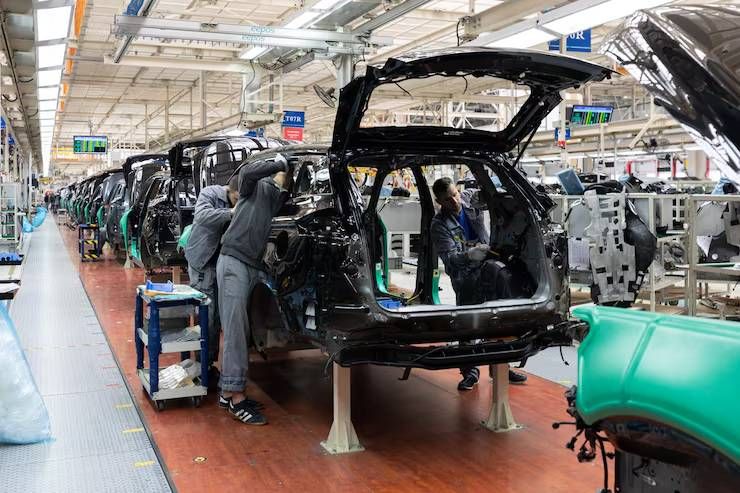
Automotive machinery refers to the industrial equipment, automated systems, and specialized tools used to manufacture, assemble, inspect, and test vehicles and their components. These machines are essential to the production of passenger cars, commercial vehicles, motorcycles, electric vehicles, and automotive replacement parts.
Automotive manufacturing has developed from labor-intensive workshops into highly organized production environments that combine mechanical equipment, electronics, computer-controlled machines, and industrial robotics. Modern automotive plants often use interconnected production lines to coordinate manufacturing stages and maintain consistent product specifications.
The machinery used in an automotive factory varies according to the vehicle design, production volume, materials, and manufacturing methods. A facility producing electric vehicles, for example, may require battery assembly and testing equipment, while a conventional engine plant needs specialized machining and engine assembly systems.
Main categories of automotive machinery
Automotive machinery can be grouped according to the manufacturing task it performs.
Metal forming equipment shapes steel, aluminum, and other materials into vehicle body panels and structural components.
CNC machine tools manufacture precision components such as shafts, housings, gears, and engine parts.
Welding and joining equipment connects metal components using resistance welding, laser welding, arc welding, and other methods.
Industrial robots perform repetitive operations such as material handling, welding, adhesive application, and painting.
Automotive assembly equipment supports the installation of engines, transmissions, seats, dashboards, wheels, and other components.
Inspection and testing equipment checks dimensions, electrical performance, mechanical properties, and product quality.
Electric vehicle production machinery supports battery cell processing, module assembly, battery pack integration, and electric motor manufacturing.
Each category contains multiple machine types, and a single automotive plant may use hundreds of individual machines arranged across specialized production areas.
Importance of Automotive Machinery
Automotive machinery plays a central role in vehicle manufacturing because modern vehicles contain thousands of components that must fit together accurately and function reliably. Production equipment helps manufacturers maintain dimensional consistency, control manufacturing processes, and coordinate operations across large production volumes.
Without suitable machinery, many automotive manufacturing activities would require substantially more manual work and could become difficult to repeat consistently. Automated equipment also allows factories to perform tasks involving heavy materials, high temperatures, hazardous substances, or repetitive movements under controlled operating conditions.
How automotive machinery supports production
Precision manufacturing: CNC machining centers and specialized cutting machines produce components within specified dimensional tolerances. Accurate machining is particularly important for parts that interact with bearings, shafts, gears, and other moving components.
High-volume production: Automated transfer systems, assembly lines, and robotic workstations coordinate repeated operations. Their configurations depend on production targets, product variety, and the level of automation required.
Product quality: Measurement systems, machine vision, and automated inspection equipment identify dimensional deviations, surface defects, and assembly errors. Inspection results can help manufacturers investigate recurring problems.
Worker safety: Robots and material-handling systems can reduce direct exposure to some hazardous operations. However, machinery introduces risks involving moving parts, electrical energy, and unexpected startup, so protective guarding and safety procedures remain necessary.
Manufacturing flexibility: Reprogrammable robots, CNC machines, and modular production systems can accommodate certain changes in vehicle models or component designs. The extent of flexibility depends on tooling, equipment capacity, and production-line configuration.
Automotive machinery and electric vehicles
Electric vehicle production has expanded the range of machinery used in the automotive sector. Although electric vehicles share many manufacturing processes with conventional vehicles, their battery systems, electric motors, power electronics, and thermal management components introduce additional requirements.
Battery production may involve electrode coating, drying, calendering, cell assembly, electrolyte filling, formation testing, and battery pack integration. Electric motor production can require winding equipment, rotor balancing machines, precision machining systems, and electrical testing instruments.
Battery technologies differ in their chemistry and physical design, so equipment requirements are not identical across all production lines. Safety controls are especially important when handling electrical energy, sensitive battery materials, and high-voltage vehicle systems.
Types of Automotive Manufacturing Machines
Automotive factories use different machines for body construction, component production, surface treatment, assembly, and testing. Equipment selection depends on material type, production speed, component complexity, and the required level of precision.
Metal forming and stamping machines
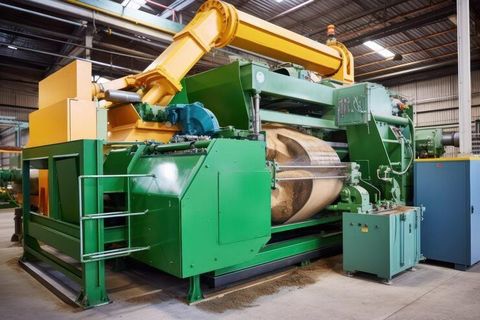
Metal stamping presses transform sheet metal into vehicle doors, hoods, roof panels, floor sections, and structural components. The process uses dies and controlled force to cut or shape metal into the required geometry.
Common equipment includes hydraulic presses, mechanical presses, transfer presses, and progressive die stamping systems. Hydraulic presses provide controlled force over the stroke, while mechanical presses are widely used for high-speed production operations. The choice depends on the component design and production requirements.
CNC machining and cutting equipment
Computer numerical control (CNC) machines use programmed instructions to control cutting tools and produce precise components. Automotive manufacturers use CNC turning centers, milling machines, drilling machines, grinding machines, and multi-axis machining centers.
These machines are used to manufacture transmission housings, brake components, engine parts, steering components, and other precision-engineered products. Laser cutting, waterjet cutting, and plasma cutting equipment are also used for different material thicknesses and manufacturing applications.
Robotic welding and joining systems
Vehicle body manufacturing involves joining numerous metal panels and structural parts. Robotic welding systems automate many of these operations, particularly resistance spot welding and certain arc-welding applications.
Other joining technologies include laser welding, friction stir welding, riveting, adhesive bonding, and mechanical fastening. Manufacturers select the process according to material combinations, joint strength requirements, accessibility, and production conditions.
Painting and surface treatment equipment
Automotive painting systems prepare surfaces and apply protective or decorative coatings. Equipment may include cleaning systems, pretreatment lines, electrocoating tanks, spray booths, curing ovens, and paint-handling robots.
Surface preparation is important because contaminants and uneven coatings can affect adhesion, corrosion resistance, and appearance. Ventilation, chemical handling, fire protection, and emissions management are important considerations in paint facilities.
Assembly line machinery
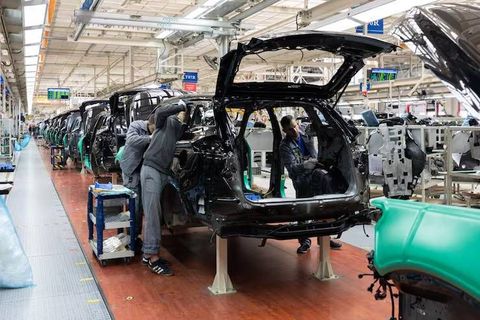
Assembly equipment supports the installation and fastening of vehicle components. Common systems include conveyor lines, automated screwdrivers, lifting platforms, robotic handling equipment, torque-controlled fastening tools, and component positioning fixtures.
Some factories use flexible assembly cells that can accommodate different vehicle variants. Others use dedicated lines designed around a more standardized production sequence.
Inspection and testing equipment
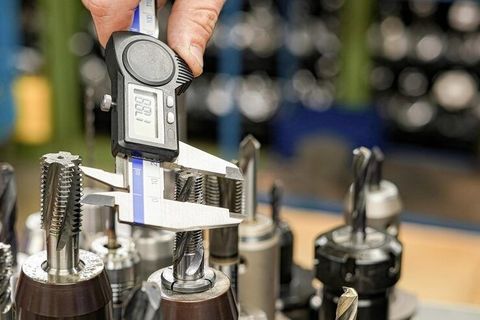
Inspection machinery checks whether components and finished vehicles meet defined specifications. Common equipment includes coordinate measuring machines, optical inspection systems, laser measurement devices, wheel alignment systems, brake testers, and electronic diagnostic equipment.
Testing may also include leak detection, vibration analysis, electrical continuity checks, and end-of-line functional testing. The tests required depend on the component and the relevant vehicle safety and quality requirements.
Comparison of automotive machinery
Machine category | Primary function | Typical application |
|---|---|---|
Stamping press | Shapes sheet metal | Doors and body panels |
CNC machining center | Produces precision parts | Housings and mechanical components |
Industrial robot | Performs programmed tasks | Welding and material handling |
Paint system | Applies protective coatings | Vehicle body finishing |
Assembly equipment | Installs and fastens components | Vehicle assembly lines |
Coordinate measuring machine | Measures component geometry | Dimensional quality control |
Battery testing system | Evaluates electrical performance | Battery production and validation |
Manufacturing Technologies and Production Processes
Automotive production involves a sequence of connected operations. Each stage transforms raw materials or components into a finished vehicle while applying inspection and process controls.
Major stages of vehicle manufacturing
1. Product design and engineering: Engineers develop vehicle structures, mechanical systems, electrical architecture, and component specifications. Computer-aided design (CAD) and computer-aided engineering (CAE) tools help evaluate dimensions, material behavior, and assembly requirements before physical production begins.
2. Material processing: Steel, aluminum, plastics, glass, and other materials are processed into components. Methods may include casting, forging, extrusion, stamping, injection molding, and precision machining.
3. Body-in-white production: Pressed metal panels and structural parts are joined to create the vehicle body structure before painting. Automated welding cells and positioning fixtures help maintain alignment across the assembly.
4. Surface preparation and painting: The body undergoes cleaning, pretreatment, coating application, and curing. Process monitoring helps maintain coating thickness, adhesion, and finish consistency.
5. Component and powertrain assembly: Engines, transmissions, electric motors, battery systems, suspension assemblies, and other components are produced or installed according to the vehicle architecture.
6. Final vehicle assembly: Interior components, electrical systems, glass, wheels, seats, and other parts are installed. Fastening tools, lifting equipment, and conveyor systems support the assembly sequence.
7. Inspection and validation: Finished vehicles undergo checks for assembly accuracy, electrical operation, braking performance, lighting, fluid leakage, and other specified characteristics. Additional validation may occur during development and production approval.
Not every factory performs every stage on the same site. Some plants focus on vehicle assembly, while specialized suppliers manufacture components or complete subsystems separately.
Automation, robotics, and smart manufacturing
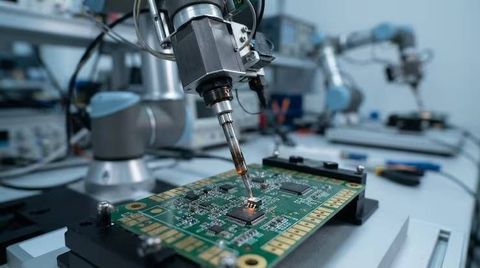
Automotive production increasingly combines programmable machinery with sensors, industrial networks, and production management software. Industrial robots can carry out repetitive tasks, while machine vision systems inspect components and detect selected defects.
Manufacturing execution systems (MES) track production orders, work progress, material usage, and quality information. Industrial Internet of Things (IIoT) platforms can collect operational data from connected machines, helping production teams monitor equipment conditions and investigate interruptions.
Digital twins and simulation software can represent production lines or individual machines in a virtual environment. Engineers use these models to study layouts, evaluate production scenarios, and examine possible process changes before making physical modifications.
Automation does not eliminate the need for human oversight. Equipment programming, maintenance, quality verification, safety management, and process improvement continue to require trained personnel.
Recent Developments in Automotive Machinery
Automotive manufacturing is changing as vehicle makers expand electric vehicle production, introduce software-controlled production systems, and seek more flexible manufacturing arrangements. Developments across 2024–2026 have continued to emphasize automation, digital monitoring, battery production, and improved coordination between equipment and production software.
Electric vehicle production equipment
Battery manufacturing and electric powertrain production have become important areas of machinery development. Battery production lines may incorporate precision coating equipment, controlled-environment assembly systems, automated handling, electrical testing, and leak detection.
Electric motor manufacturing also uses specialized winding, balancing, machining, and testing equipment. As battery designs and motor architectures vary, factories must adapt machinery to the materials, component geometry, and quality requirements of each production process.
Artificial intelligence and machine vision
AI-based inspection systems can analyze images to identify selected surface defects, missing components, or assembly irregularities. Compared with conventional inspection arrangements, these systems can support more extensive analysis of visual data, although performance depends on training data, lighting, camera configuration, and validation.
Manufacturers are also applying data analytics to equipment monitoring and production planning. These tools may help identify recurring stoppages, unusual machine behavior, or patterns in production defects. Human review remains important when findings affect safety or product acceptance.
Flexible manufacturing and digital integration
Flexible production systems allow selected machines and workstations to accommodate changes in product configuration. Reprogrammable robots, modular fixtures, automated guided vehicles, and coordinated production software can support material movement and manufacturing flexibility.
Factories are also integrating operational data with maintenance, inventory, and quality systems. This can improve production visibility, but connecting more equipment also increases the importance of cybersecurity, reliable networks, software updates, and access controls.
Laws, Standards, and Safety Requirements
Automotive machinery must comply with applicable requirements covering machine safety, electrical systems, environmental controls, product quality, and worker protection. The relevant rules depend on the country, machinery type, intended application, and whether the equipment is used to manufacture vehicles or test finished products.
Regulatory considerations in India
Indian automotive manufacturing facilities must consider applicable occupational safety, factory, electrical safety, environmental, and fire protection requirements. The Occupational Safety, Health and Working Conditions Code, 2020, forms part of India's occupational safety and labour-law framework; its application depends on the relevant commencement provisions and implementing requirements.
Vehicle manufacturers and component producers may also need to follow applicable requirements established by the Ministry of Road Transport and Highways, the Bureau of Indian Standards, and other relevant authorities. Requirements vary according to the vehicle category, component, and specific regulatory obligation.
Environmental rules can affect paint booths, industrial emissions, wastewater treatment, hazardous materials, and waste handling. Facilities must identify the approvals and operating conditions that apply to their processes.
International technical standards
Several international standards and frameworks are relevant to automotive machinery and manufacturing quality.
ISO 12100: Provides principles for machinery risk assessment and risk reduction.
ISO 10218: Addresses safety requirements for industrial robots and robotic applications within its defined scope.
ISO 13849: Covers safety-related parts of machinery control systems.
ISO 9001: Establishes requirements for quality management systems.
IATF 16949: Specifies quality management system requirements for organizations in the automotive production and relevant service-parts supply chain.
Standards may be required by law, customer specifications, certification arrangements, or contractual agreements. They do not automatically replace applicable national regulations or the need for a task-specific risk assessment.
Tools and Resources for Automotive Machinery
Manufacturers use engineering software, measurement instruments, maintenance platforms, and quality management systems to plan and operate automotive production equipment.
Common industrial tools
CAD and CAE software: Supports vehicle design, component modelling, structural analysis, and engineering simulation.
CAM software: Converts manufacturing designs into instructions for compatible CNC machines and other production equipment.
PLC and robot programming systems: Configure programmable logic controllers and industrial robots to perform defined production sequences.
Manufacturing execution systems: Record production activity, component traceability, work progress, and quality information.
Condition monitoring systems: Use measurements such as vibration, temperature, and motor current to help assess machinery performance.
Metrology equipment: Includes coordinate measuring machines, optical measurement systems, gauges, and laser scanners used to verify dimensions and component geometry.
Factors to consider when selecting machinery
Equipment evaluation generally involves production capacity, material compatibility, dimensional accuracy, cycle time, maintenance requirements, energy use, operator safety, and integration with existing systems.
Manufacturers also examine tooling requirements, spare-parts availability, calibration procedures, and workforce training. A machine must be suitable for the intended process and comply with the applicable technical and safety requirements.
Frequently Asked Questions
What is automotive machinery used for?
Automotive machinery is used to manufacture, process, assemble, inspect, and test vehicle components. It includes stamping presses, CNC machines, industrial robots, painting equipment, assembly systems, and quality inspection instruments.
What machines are used in automotive manufacturing?
Common machines include hydraulic and mechanical presses, CNC machining centers, robotic welding systems, injection molding machines, conveyor systems, paint application equipment, and automated testing systems. The equipment depends on the vehicle type and production process.
What machinery is required for electric vehicle manufacturing?
Electric vehicle manufacturing may require battery cell or pack production equipment, electric motor winding machines, precision machining systems, power electronics assembly equipment, and electrical testing systems. The exact requirements depend on battery technology and vehicle design.
How does automation improve automotive production?
Automation helps coordinate repetitive operations, maintain consistent production sequences, and collect process data. Robots, machine vision, and connected control systems can support production efficiency and quality inspection, but they require proper programming, maintenance, and safety controls.
Who manufactures automotive machinery?
Automotive machinery is produced by industrial equipment manufacturers specializing in robotics, machine tools, stamping presses, assembly systems, automation controls, and inspection equipment. Some companies supply individual machines, while others develop integrated production lines for specific manufacturing processes.
Conclusion
Automotive machinery supports the production of vehicle bodies, mechanical components, electric powertrains, and finished vehicles. Technologies such as CNC machining, industrial robotics, automated inspection, and connected manufacturing systems contribute to precision, production coordination, and quality control. Electric vehicle manufacturing is expanding the range of specialized battery and motor production equipment used across the industry. Machinery selection and operation depend on production requirements, technical standards, maintenance needs, and workplace safet