Industrial heavy equipment refers to large, powerful machines used to perform demanding tasks in construction, mining, manufacturing, infrastructure development, agriculture, and material handling. These machines are designed to move heavy loads, excavate earth, process raw materials, lift structures, and support operations that require substantial mechanical force.
Unlike ordinary industrial tools, heavy equipment typically combines structural steel components, hydraulic or electric drive systems, engines or motors, and specialized attachments. Its design depends on the working environment, load capacity, operating conditions, and the type of task being performed.
Industrial heavy equipment has developed alongside advances in mechanical engineering, metallurgy, hydraulics, and power generation. Early machines relied heavily on steam power and mechanical transmission systems. Modern equipment increasingly uses electronic controls, sensors, automated functions, and alternative power systems to manage complex industrial operations.
Main types of industrial heavy equipment
Heavy machinery covers several categories, each designed for specific applications.
Earthmoving equipment: Excavators, bulldozers, wheel loaders, and motor graders used to dig, move, and level soil or rock.
Lifting equipment: Mobile cranes, tower cranes, rough-terrain cranes, and heavy-duty lifting systems used to handle large loads.
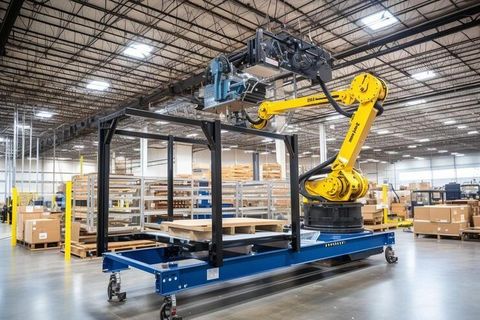
Material handling equipment: Forklifts, reach stackers, container handlers, and industrial telehandlers used to move materials within facilities.
Mining equipment: Drilling rigs, haul trucks, underground loaders, and crushing equipment used in mineral extraction and processing.
Road construction equipment: Asphalt pavers, road rollers, milling machines, and compactors used in road building and maintenance.
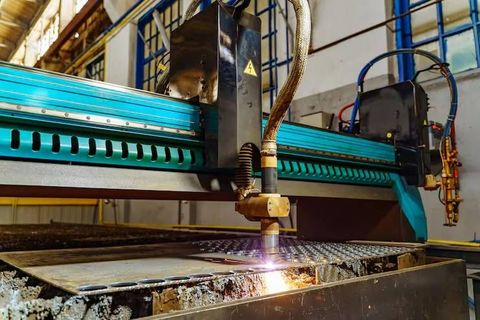
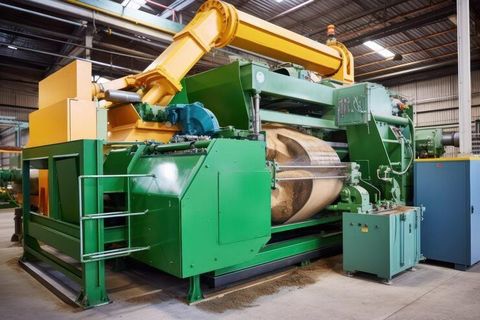
Industrial processing machinery: Large presses, shredders, crushers, and specialized production machines used in manufacturing and material processing.
Concrete equipment: Concrete pumps, batching plants, transit mixers, and placing equipment used in construction projects.
Equipment categories can overlap. A wheel loader, for example, may be used at a construction site, a mining operation, a recycling facility, or an industrial warehouse, depending on its configuration.
Major components of heavy machinery
Heavy equipment consists of interconnected mechanical, electrical, and hydraulic systems.
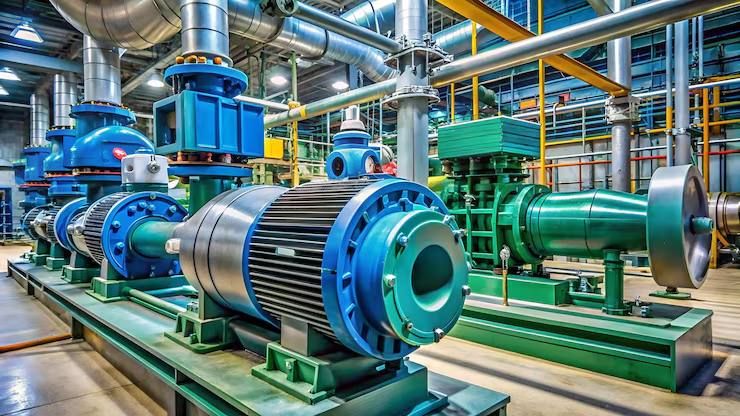
The chassis or main frame supports the machine's structure and operating loads. Engines or electric motors provide power, while transmissions and drive systems transfer that power to wheels, tracks, or working mechanisms. Hydraulic cylinders and pumps operate attachments such as excavator arms, lifting booms, and loader buckets.
Electronic control units, pressure sensors, cameras, and operator displays help manage machine functions. Depending on the design, additional systems may include cooling equipment, braking mechanisms, filtration units, load-monitoring devices, and safety interlocks.
Importance of Industrial Heavy Equipment
Heavy equipment supports activities that would otherwise require extensive manual labor or large teams using smaller machines. It is essential to modern infrastructure, mining, industrial production, and the movement of bulk materials.
Construction projects use excavators and loaders to prepare sites, cranes to lift structural components, and compactors to prepare road surfaces. Mining operations use specialized equipment to remove overburden, transport extracted materials, and support processing activities.
Manufacturing facilities also depend on heavy equipment to handle steel coils, large castings, industrial containers, machinery components, and other materials that cannot be moved safely by ordinary handling equipment.
How heavy equipment addresses industrial challenges
Heavy machinery helps manage several operational requirements:
High-load handling: Cranes, industrial forklifts, and specialized lifting machines move materials beyond the practical capacity of standard handling tools.
Large-scale excavation: Excavators and bulldozers remove soil, rock, and other materials during construction and mining.
Material transportation: Haul trucks and articulated dump trucks move bulk materials across large or uneven sites.
Surface preparation: Graders, rollers, and compactors prepare ground and road surfaces for subsequent work.
Industrial productivity: Mechanized systems support repeated tasks involving lifting, loading, crushing, and material movement.
Operational consistency: Machines equipped with measurement and control systems can help operators perform tasks within specified working parameters.
The effectiveness of a machine depends on its suitability for the task, operator skill, maintenance condition, and the characteristics of the working site.
Industries that rely on heavy equipment
Industrial heavy equipment is used across multiple sectors.
Industry | Typical equipment | Main application |
|---|---|---|
Construction | Excavators, cranes, loaders | Site preparation and structural work |
Mining | Haul trucks, drilling rigs | Extraction and material transportation |
Manufacturing | Industrial presses, heavy forklifts | Production and material handling |
Ports and logistics | Container handlers, reach stackers | Cargo movement and stacking |
Agriculture | Tractors, large harvesters | Land preparation and crop operations |
Road infrastructure | Pavers, graders, rollers | Road construction and maintenance |
Waste processing | Industrial shredders, loaders | Waste handling and material reduction |
The equipment selected for each industry reflects its operating environment, capacity requirements, safety considerations, and production processes.
Recent Developments in Industrial Heavy Equipment
Industrial heavy equipment is changing through advances in electrification, digital monitoring, automation, and machine design. Developments from 2024 through 2026 reflect efforts to improve equipment visibility, reduce unnecessary energy use, and support safer operation across construction, mining, and manufacturing environments.
Electrification and alternative power systems
Battery-electric machinery is gaining attention in applications where operating conditions and charging infrastructure make electrification practical. Electric compact loaders, excavators, forklifts, and selected underground mining machines can reduce direct exhaust emissions at the point of use.
Hybrid equipment combines an internal combustion engine with electric components to manage power demand. Hydrogen-based power systems and other alternative fuels are also being evaluated for selected heavy-duty applications, although adoption depends on infrastructure, energy availability, equipment requirements, and operating conditions.
Electrification is not suitable for every machine or site. Large equipment operating continuously in remote locations may face challenges involving charging time, battery capacity, power availability, and extreme environmental conditions.
Automation and remote operation
Automation technologies are increasingly used in mining, earthmoving, and industrial material handling. Machine guidance systems can use satellite positioning, cameras, laser-based measurements, and onboard sensors to help operators follow planned paths or maintain specified working depths.
Remote operation allows selected machines to be controlled from a location away from the immediate working area. This can be useful in environments involving unstable ground, dust, high temperatures, or other hazards. Fully autonomous operation remains dependent on the task, operating environment, safety systems, and regulatory requirements.
Telematics and predictive maintenance
Telematics systems collect information about machine location, engine hours, fuel or electricity use, operating temperature, fault codes, and component performance. Fleet managers can use this information to monitor utilization and coordinate maintenance activities.
Predictive maintenance systems analyze operating data to identify patterns associated with possible component deterioration. These systems can support maintenance planning, but they do not eliminate the need for inspections, qualified technicians, and manufacturer-specific maintenance procedures.
Safety and operator assistance
Modern heavy equipment may include rear-view cameras, proximity detection, collision warnings, load indicators, rollover protection, and electronic stability or braking controls. Some machines also use operator-presence detection and systems that limit particular movements under specified conditions.
Such technologies can improve situational awareness, but their effectiveness depends on correct configuration, maintenance, operator training, and the working environment. They do not replace established safety procedures or appropriate site supervision.
Laws, Regulations, and Safety Standards
Industrial heavy equipment is subject to requirements covering machine safety, operator competence, lifting operations, environmental impacts, and workplace conditions. The exact requirements depend on the machine type, its intended use, the industry, and the country where it operates.
Regulatory considerations in India
In India, applicable workplace and equipment requirements may arise under occupational safety legislation, factory regulations, state-specific rules, and sector-specific provisions. The Occupational Safety, Health and Working Conditions Code, 2020, forms part of the country's occupational safety framework; its application must be assessed against commencement provisions and the relevant rules in force.
Construction equipment, cranes, forklifts, and other lifting machinery may have specific inspection, testing, operating, or certification requirements. Employers and equipment operators must determine which provisions apply to the particular machine and workplace.
Environmental requirements may also affect heavy equipment through emission standards, noise limits, and restrictions on the operation of certain diesel-powered machinery in designated locations. Requirements can differ by equipment category and local jurisdiction.
International safety and technical standards
Several international standards and technical frameworks are relevant to heavy machinery:
ISO 20474: Addresses safety requirements for earth-moving machinery.
ISO 12100: Provides principles for machinery risk assessment and risk reduction.
ISO 13849: Covers safety-related parts of machinery control systems.
ISO 50001: Provides a framework for managing and improving energy performance.
Applicable lifting-equipment standards: Address matters such as rated capacity, structural integrity, inspection, and safe operation, depending on the equipment category.
Standards are not automatically legal requirements in every country. Their application depends on local legislation, equipment certification requirements, contracts, and industry practices.
Operator training and equipment inspection
Safe operation requires appropriate training, pre-use checks, and an understanding of the machine's operating limits. Inspection procedures may cover brakes, tires or tracks, hydraulic hoses, lifting components, warning devices, protective structures, and fluid levels.
For lifting equipment, load charts and rated capacity information must be understood in relation to the machine configuration, boom position, ground conditions, and load characteristics. Modifications or attachments can change machine performance and may require additional technical assessment.
Tools and Resources for Industrial Heavy Equipment
Selecting and operating heavy equipment involves evaluating machine capacity, site conditions, maintenance requirements, energy use, and safety controls. Manufacturers, fleet managers, engineers, and operators use technical documentation and digital tools to support these activities.
Common equipment management tools
Fleet management systems: Track machine location, operating hours, utilization, and maintenance schedules across multiple sites.
Telematics platforms: Collect machine data and provide information about operating conditions, fault codes, and equipment activity.
Equipment selection software: Helps compare machine dimensions, rated capacities, attachment compatibility, and operating specifications against project requirements.
Computer-aided design (CAD): Supports the design and development of machinery frames, hydraulic arrangements, attachments, and mechanical assemblies.
Maintenance management software: Organizes inspection schedules, repair histories, component replacement records, and maintenance tasks.
Load monitoring systems: Display or record lifting loads and related operating parameters on compatible cranes and lifting equipment.
Factors to consider when selecting equipment
The selection process generally considers the following factors:
Operating capacity and expected workload.
Site dimensions, ground conditions, and access restrictions.
Power source and energy requirements.
Compatibility with attachments and supporting machinery.
Operator visibility, protective systems, and ergonomic design.
Maintenance access, spare component availability, and technical support.
Applicable safety, emissions, and inspection requirements.
Equipment specifications should be assessed in the context of actual working conditions. A machine's published capacity may not represent its usable capacity in every configuration or environment.
Frequently Asked Questions
What is industrial heavy equipment?
Industrial heavy equipment consists of large machines designed for demanding tasks such as excavation, lifting, material transportation, mining, road construction, and industrial processing. Examples include excavators, cranes, bulldozers, haul trucks, and heavy-duty forklifts.
What are the main types of heavy machinery?
The main categories include earthmoving equipment, lifting machinery, material handling systems, mining equipment, road construction machinery, and industrial processing equipment. Each category contains machines designed for particular operating conditions and tasks.
How is industrial heavy equipment manufactured?
Manufacturing typically involves engineering design, material selection, steel fabrication, machining, component assembly, hydraulic and electrical integration, software configuration, and functional testing. The precise process depends on the machine's size, design, and intended application.
How is technology changing heavy equipment?
Telematics, machine guidance, remote operation, electrification, and predictive maintenance are changing how heavy equipment is operated and maintained. Adoption varies according to machine type, infrastructure, operating conditions, and safety requirements.
What maintenance does heavy equipment require?
Typical maintenance includes checking fluids, filters, tires or tracks, hydraulic systems, brakes, structural components, electrical systems, and safety devices. Inspection intervals and maintenance procedures depend on the machine, its operating environment, and the manufacturer's instructions.
Conclusion
Industrial heavy equipment supports construction, mining, manufacturing, logistics, agriculture, and infrastructure development through specialized lifting, excavation, transportation, and processing capabilities. Advances in electrification, automation, telematics, and predictive maintenance are influencing equipment design and operation. Safe and reliable use depends on suitable machine selection, trained operators, regular maintenance, and compliance with applicable technical and legal requirements.